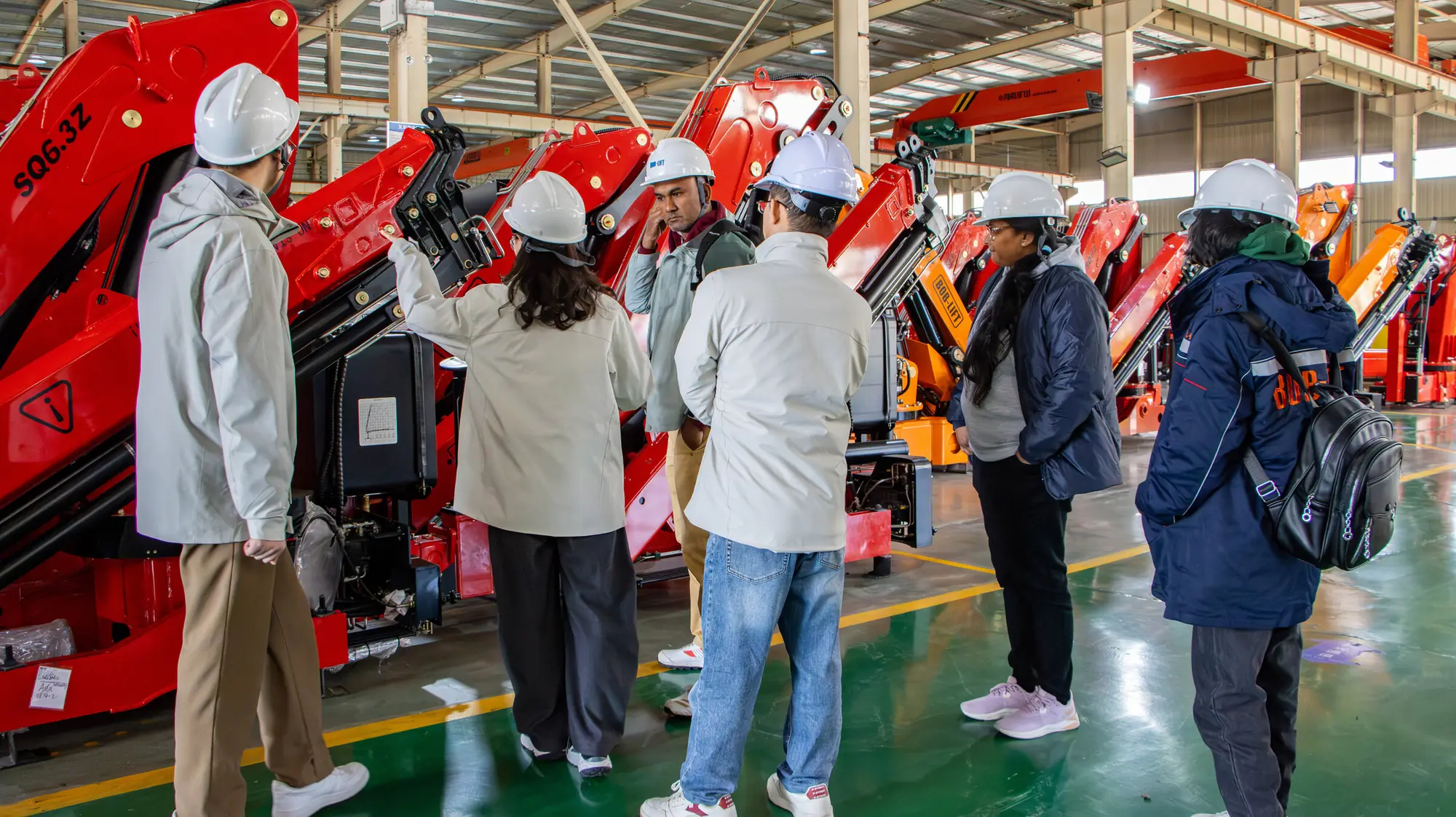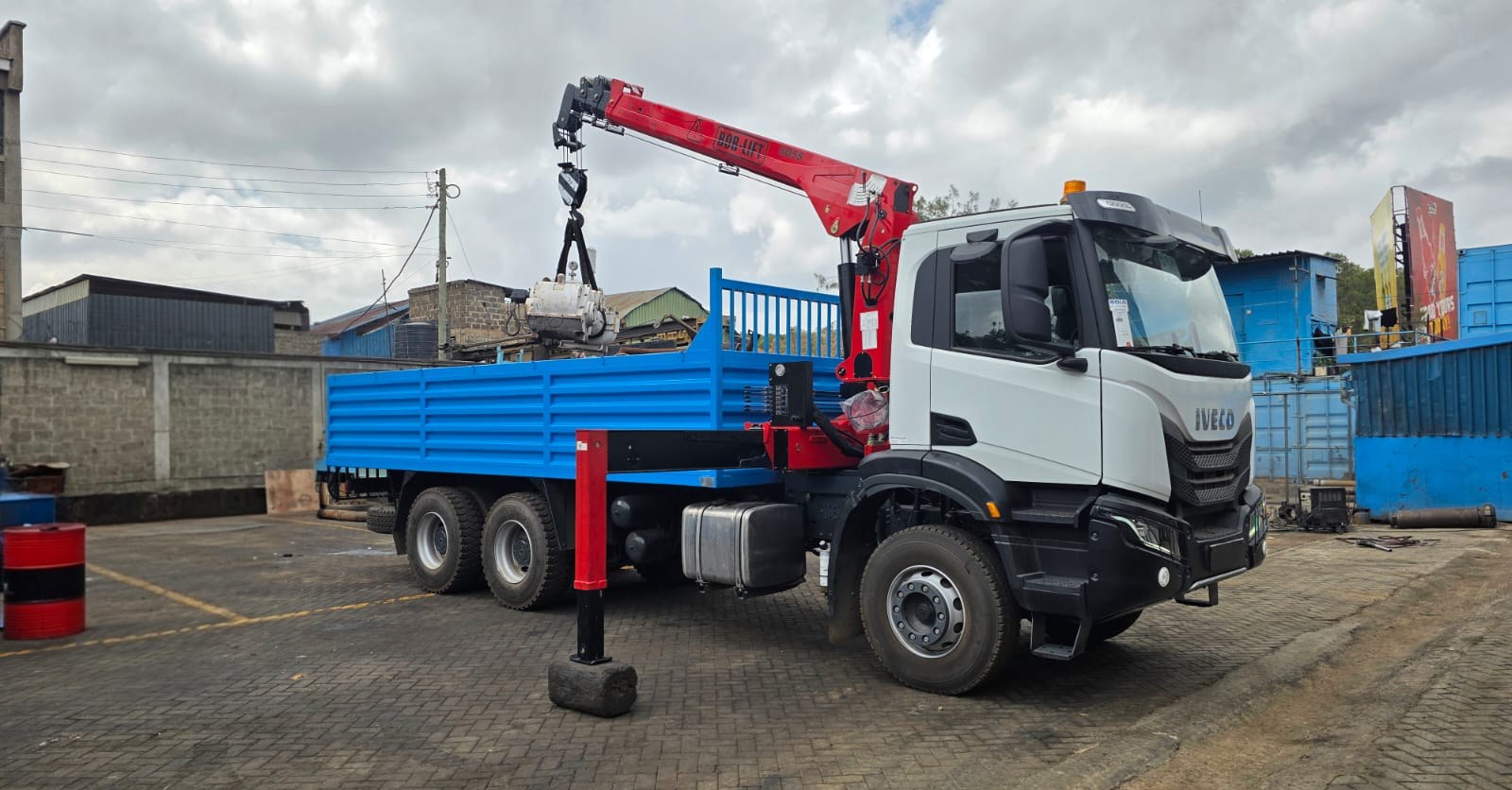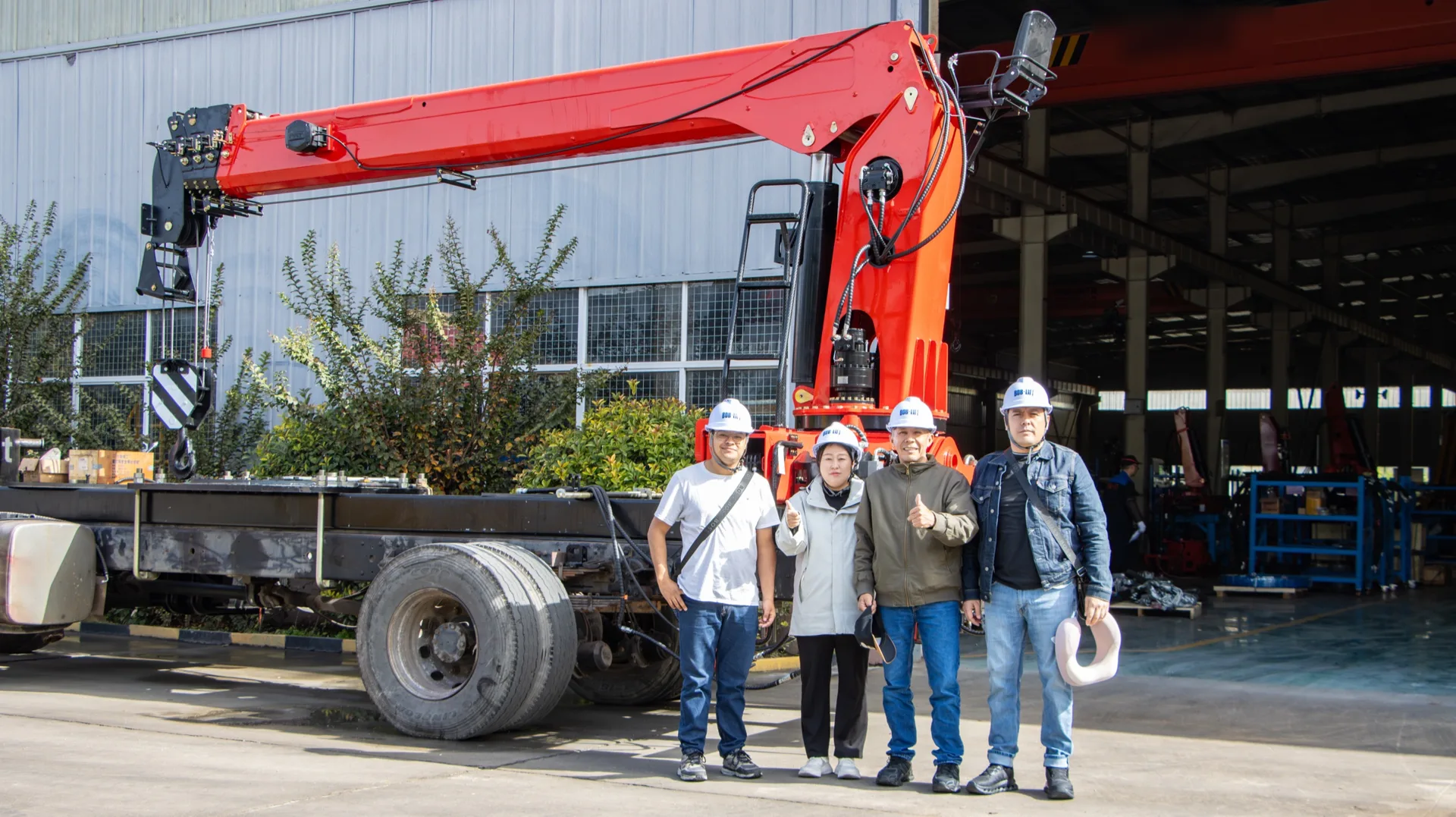

The main advantage of a truck mounted crane for transport is that one vehicle carries the load and lifts it. No second machine is needed at either end of the trip. The truck also travels on public roads, sets up on its own outriggers and costs less to operate when correctly sized, and the crane gives precise control, fits restricted sites and works in many industries. A truck mounted crane is a hydraulic crane fitted to a truck chassis, usually behind the cab, that loads and unloads the truck’s own cargo and places loads beside it.
We have manufactured truck mounted cranes in Xuzhou since 2003, and this guide explains each advantage with figures from our technical drawings, then covers the limits, the checks before a trip and which of our cranes suits which job. If you are new to these machines, start with our guide to what a truck mounted crane is and how it works.
Key takeaways
- A single vehicle loads, transports and unloads, so a delivery does not depend on a forklift or a second crane on site.
- The crane travels stowed and sets up on outriggers that need from about 3,500 mm of width on our 3,200 kg crane to 8,600 mm on our 50 t crane.
- The cheapest crane to run is the smallest one that covers your loads, because a bigger crane weighs more and draws more power.
- Our drawings rate small knuckle boom cranes at 330° to 400° of slewing and larger cranes at 360°.
- Capacity, reach and payload are lower than on a large mobile crane, and MIAOXUE cranes never lift people.
1. One vehicle carries and lifts the load
The first advantage is that the truck loads and unloads itself. Wikipedia describes a loader crane as “a hydraulically powered articulated arm fitted to a truck or trailer” that “is used for loading/unloading the vehicle cargo” [1]. A plain truck needs a forklift or a crane at the yard and again at the site, while a truck mounted crane picks up the load, drives, sets up and puts it down without waiting for another machine. There is no second booking to arrange and no second vehicle on the road, as the diagram shows.

Example scenario (an illustration, not a customer record): a builders’ merchant delivers pallets of blocks with our SQ3.2ZA3 knuckle boom crane, and we assume each pallet, with its pallet fork, weighs 1,000 kg. The load chart rates the crane at 1,350 kg at 4,350 mm but only 910 kg at 5,900 mm. The driver can therefore set a pallet down 4,350 mm from the slewing centre, but must park closer when the drop point is further away.
2. Road mobility and quick set-up at the delivery point
A truck mounted crane goes wherever the truck may legally go. The crane travels folded or retracted in its transport position, with the outriggers pulled in to roughly the width of the truck. At the site, the operator parks, engages the hydraulics, extends and lowers the outriggers and unfolds the boom, with no assembly and no separate transport for the crane.
Set-up time depends on the crane, the ground and the operator, so we don’t promise a figure, but we can specify the space it needs. Our drawings give the outrigger span from retracted to fully extended as 2,250 to 3,513 mm on the SQ3.2ZA3 and 2,293 to 5,593 mm on the SQ5SA4 telescopic crane, while the SQ8ZA5 knuckle boom requires 2,310 to 5,610 mm. Our guide to crane outriggers and ground bearing pressure lists more models and shows how to size outrigger pads.

The ground must support the outriggers wherever you stop. The US crane regulation, 29 CFR 1926.1402, says equipment must not be used “unless ground conditions are firm, drained, and graded to a sufficient extent” to meet the manufacturer’s requirements [2]. A rapid set-up is only possible when the ground conditions are suitable.
3. Lower operating cost and fuel use for transport work
Which truck mounted cranes offer the best fuel efficiency and operating costs? No single model does, because the most economical crane to operate is the smallest one whose load chart covers your real loads at your real radius. We publish no fuel consumption figures, but the operating cost factors are clear.
- One trip instead of two: a single vehicle does the carrying and the lifting, so no second machine travels to the site and back.
- Hydraulics that run only while you lift: a power take-off (PTO) is a drive from the truck’s engine or gearbox that powers other equipment. Wikipedia notes that “in the majority of cases, the PTO will connect directly to a hydraulic pump” [3]. The operator engages it for lifting operations and disengages it before travelling.
- Power that grows with size: our drawings recommend 14 kW for the SQ3.2ZA3 and 25 kW for the SQ8ZA5, rising to 75 kW for the 50 t SQZ1000.
- Crane weight against payload: every kilogram of crane is a kilogram of cargo you can’t carry, from 1,330 kg for the SQ3.2ZA3 to 10,000 kg for the SQZ1000.
Oversizing is the most common way to waste money, because a crane that is too big needs a heavier truck, carries less cargo and draws more power on every lift. For light, occasional loads on a pickup or small truck, for example, our electric-hydraulic SQ1Z-E (1 t) and SQ2Z-E (2 t) run from a battery instead of the PTO. Our electric truck mounted crane guide explains when that makes sense, and the guide to the hydraulic supply a truck mounted crane needs covers pump matching.
4. Precise, controlled lifting
Hydraulic control valves let the operator move each boom function slowly and smoothly, so a load can be set down gently on a deck, a rack or a foundation. Our knuckle boom and telescopic cranes come with manual levers as standard, and a high seat or a wireless remote control on request, as our crane remote control guide explains. Every MIAOXUE crane is listed with a load moment limiter, as our article on the lifting moment of a crane explains, but a limiter is a backstop and not a substitute for the load chart.
Slewing is the rotation of the crane column, and it lets the hook reach either side of the truck and the area behind it without moving the vehicle. Our drawings rate the SQ1ZA3+1 at 330°, the SQ3.2ZA3 at 400° and the SQ5SA4, SQ8ZA5 and SQ12ZA4 at 360°. A 330° crane leaves a small sector the hook cannot enter, which should sit over the cab. Our guide to how a truck mounted crane slewing drive works and how far each model turns covers the details.
The boom type determines the rest of the control: a knuckle boom folds and reaches over obstacles, and our SQ8ZA5 reaches 12.63 m with 1,160 kg on the hook. A telescopic boom provides a long straight reach, and our SQ5SA4 reaches 11.79 m with 600 kg. The knuckle boom vs telescopic boom comparison explains which suits which work.
5. Works on tight sites and kerbside deliveries
A truck mounted crane occupies little more space than the truck itself. Wikipedia notes that a loader crane’s “numerous jointed sections can be folded into a small space when the crane is not in use” [1]. Our drawings show the SQ3.2ZA3 folded to 725 mm wide and about 2,040 mm high, and the SQ8ZA5 folded to 1,031 mm wide and 2,340 mm high, which leaves most of the deck free for cargo.
On site, a knuckle boom can lift a load over a wall or fence and place it in a yard the truck cannot enter, which suits streets, gardens and small building plots. Where even a light truck is too big, our smallest cranes fit pickups; the SQ08ZA3, for instance, lifts 800 kg and weighs 365 kg. Our small truck mounted crane guide compares the light models, and the flatbed crane truck guide shows how the crane position affects deck length.
6. Versatile across industries, including utility line work
The same machine serves very different industries, because it is a truck that lifts.
- Construction and building supply: blocks, steel, formwork and site cabins delivered to the point of use.
- Logistics and machinery moving: machines, tanks and equipment loaded at one site and set down at another.
- Utilities: poles, cable drums and kerb units delivered along a route, stop after stop.
- Ports, farms and forestry: our marine cranes handle cargo on vessels, and our timber crane guide covers log loading.
Attachments widen the range further: a winch, an earth auger or a grapple can be fitted on request, as our guide to knuckle boom crane attachments explains. For warehouses, our forklift fly jib cranes turn a forklift into a small crane.
Which truck mounted cranes are best for utility line work? Usually a knuckle boom crane with sufficient reach to position materials beside the vehicle, sized on the heaviest item at its working radius. Overhead lines are the main hazard, and HSE guidance note GS6 lists “cranes, lorry-loader cranes” among the machinery often involved when people are hurt by them [4]. Under 29 CFR 1926.1408, precautions apply if any part of the crane, load line or load could get closer than 20 feet to a line, and our crane power line safety guide sets out the clearances.
MIAOXUE cranes never lift people, and we supply no personnel baskets. US rules prohibit hoisting employees with a crane except where conventional access “would be more hazardous, or is not possible” [5], so line crews should use an aerial lift built for work at height.
How does a truck mounted crane compare with a truck plus a hired crane?
For regular deliveries within its load chart, the truck mounted crane is simpler, while a hired mobile crane wins on very heavy or very long-reach lifts. The table below compares the two arrangements without prices, which vary by market.
| Point | Truck mounted crane | Plain truck plus hired crane |
|---|---|---|
| Vehicles on the road | One | Two, travelling separately |
| Scheduling | Your own timetable | Depends on the crane booking |
| Unloading at a second site | Same vehicle does it | Needs a crane or forklift there too |
| Capacity and reach | Limited to the crane’s load chart | Can be much larger |
| Payload | Reduced by the crane’s own weight | Full truck payload |
| Best for | Frequent loads within the chart | Rare, very heavy or very high lifts |
Source: comparison compiled by MIAOXUE, November 2026; for the wider differences between the two machine types, read our guide to truck mounted cranes vs mobile cranes.
What are the limits of a truck mounted crane?
These advantages come with limitations that you should consider before purchasing.
- Capacity and reach: even our largest cranes lift far less at long radius than large all-terrain or crawler cranes; the SQ20SA5 is rated at 1,500 kg at 22.0 m and the SQZ1000 at 3,230 kg at 20.3 m.
- Payload: the crane, its subframe and its hydraulic oil all come off the truck’s payload.
- Ground and space: the load chart only applies with the outriggers set as the manual requires, on ground that can carry them.
- Weather: wind acting on the load and the boom limits lifting, so stop at the limit given in the operator’s manual.
- Operator skill: the driver is usually also the crane operator, so both roles require proper training.
What should you know before transporting with a truck mounted crane?
Check the road side and the lifting side before the first trip, using these points as a starting list.
- Road weight and axle limits: on the US Interstate System, 23 CFR 658.17 sets 20,000 pounds on a single axle, 34,000 pounds on a tandem axle and 80,000 pounds gross [6]. Check your own country’s regulations with the crane and cargo on board.
- Crane stowed for travel: boom in its transport position, outriggers retracted and locked, PTO off. Under 29 CFR 1926.1417(u), traveling with a load is prohibited “if the practice is prohibited by the manufacturer”.
- Payload left after the crane: subtract the crane, subframe and oil from the rated payload; our truck mounted crane installation guide covers axle loads.
- Outrigger space, ground and radius: read the chart at the largest radius of the lift, as our guide on how to read a crane load chart shows.
- A plan and a competent operator: LOLER regulation 8 requires every lifting operation to be “properly planned by a competent person” [7]. See our crane lift plan guide and crane operator licence guide.
- Daily checks: work through our truck mounted crane inspection checklist before the first lift of the day.
Example scenario (an illustration, not a customer record): a truck has an assumed rated payload of 8,000 kg before any crane is fitted. Our SQ3.2ZA3 weighs 1,330 kg and leaves 6,670 kg, while the SQ8ZA5 weighs 3,250 kg and leaves 4,750 kg, both before the subframe and oil. If the heaviest item is a 600 kg pallet placed close to the truck, the smaller crane carries almost 2 t more cargo on every trip.
Which MIAOXUE truck mounted crane suits which job?
Choose by the load at the radius you need, then check the crane weight against your truck. The table gives example models across our range, with figures read from their drawings and load charts.
| Typical job | Example model | Max capacity | Load at max reach | Crane weight |
|---|---|---|---|---|
| Pickup and light service work | SQ08ZA3 knuckle | 800 kg | 300 kg at 3.23 m | 365 kg |
| Light truck deliveries | SQ1ZA3+1 knuckle | 1,600 kg | 300 kg at 4.23 m | 470 kg |
| Kerbside pallets and building supply | SQ3.2ZA3 knuckle | 3,200 kg | 680 kg at 7.7 m | 1,330 kg |
| Machinery delivery with straight reach | SQ5SA4 telescopic | 5,000 kg | 600 kg at 11.79 m | 2,400 kg |
| Construction and utility materials | SQ8ZA5 knuckle | 8,000 kg | 1,160 kg at 12.63 m | 3,250 kg |
| Heavier site and plant loads | SQ12ZA4 knuckle | 12,000 kg | 2,100 kg at 10.15 m | 4,480 kg |
| Long-reach heavy lifts | SQ20SA5 telescopic | 20,000 kg | 1,500 kg at 22.0 m | 7,300 kg |
| Heaviest loads on a heavy chassis | SQZ1000 knuckle | 50,000 kg | 3,230 kg at 20.3 m | 10,000 kg |
Source: MIAOXUE technical drawings and load charts, compiled November 2026, where reach is the horizontal radius from the slewing centre. For the largest models, see our guide to the heavy duty truck mounted crane.
Frequently asked questions
Which truck mounted cranes offer the best fuel efficiency and operating costs?
The smallest crane that covers your loads at your working radius, because a lighter crane leaves more payload, draws less power from the PTO and fits a lighter truck. For light, occasional lifts, an electric-hydraulic crane that runs from a battery is another option.
What should you check before a trip with a truck mounted crane?
Check axle and gross weight limits with the crane fitted, stow the boom and outriggers for travel, and work out the payload left after the crane. At the site, check the outrigger space, the ground, the load chart at your radius and that the operator is trained.
Which truck mounted cranes are best for utility line work?
Usually a knuckle boom crane sized on the heaviest pole, drum or unit at its working radius, often with a winch or auger fitted. Keep every part of the crane and load clear of power lines, and use an aerial lift for people, because MIAOXUE cranes never lift people.
Is a truck mounted crane cheaper than hiring a mobile crane?
For frequent deliveries within its load chart it usually is, because one vehicle performs both operations on your own schedule. For a rare, very heavy or very high lift, hiring a larger mobile crane for that day is often the better choice.
Can a truck mounted crane drive with a load on the hook?
Not unless the crane manufacturer allows it, and US rules prohibit it where the manufacturer does. Lower the load onto the deck, secure it, and return the crane to its transport position before the vehicle moves.
How we compiled this guide
We compiled the crane figures from the current MIAOXUE technical drawings and load charts of the SQ08ZA3, SQ1ZA3+1, SQ3.2ZA3, SQ5SA4, SQ8ZA5, SQ12ZA4, SQ20SA5 and SQZ1000. The rules come from the eCFR text of 29 CFR 1926.1402, 1926.1408, 1926.1417 and 1926.1431 and of 23 CFR 658.17, from LOLER regulation 8 and from HSE guidance note GS6, as they stood in November 2026. The general definitions come from Wikipedia’s crane and power take-off articles, the examples use clearly marked assumed weights, the diagram is our own and the photo was sent by a customer. We rewrote this article in November 2026 and removed claims we could not support, such as a fixed set-up time. Achord Chan, Product Operations Director, reviewed it, and it does not replace the crane’s operator’s manual or the rules where you work.
Find the right truck mounted crane for your transport work
Tell us what you carry, the heaviest item, the radius at the drop point and the truck you plan to use. We will suggest a knuckle boom or telescopic boom truck mounted crane and send its dimensions drawing and load chart. Every crane carries a 12-month warranty on the whole machine, common spare parts leave the factory within 48 hours, and our service team answers within 12 hours. Contact us for a quotation and a load chart check.